
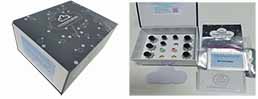
Packages (Simulation)
Reagent Preparation
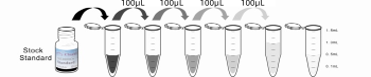
Image (I)
-
 Results demonstration
Image (II)
-
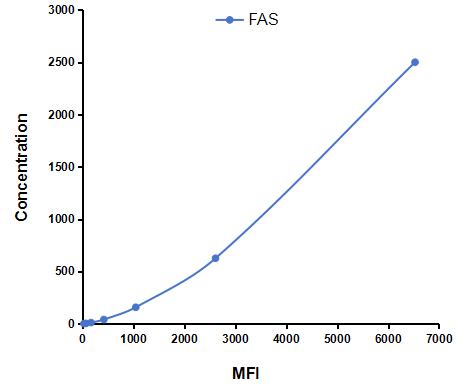 Typical Standard Curve
Quality Guarantee

Instruction Manual
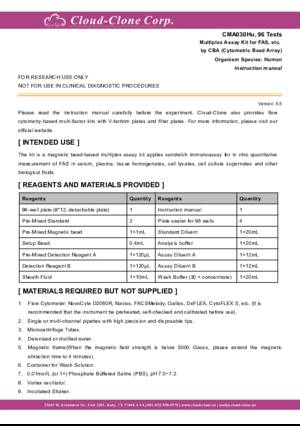
Certificate

Multiplex Assay Kit for Factor Related Apoptosis (FAS) ,etc. by CBA (Cytometric Bead Array)
CD95; ALPS1A; ALPS1-A; APO1; APT1; FAS1; FASTM; TNFRSF6; Fas Receptor; TNF Receptor Superfamily Member 6; Tumor Necrosis Factor Receptor Superfamily Member 6
- Product No.CMA030Hu
- Organism SpeciesHomo sapiens (Human) Same name, Different species.
- Sample TypeSerum, plasma, tissue homogenates, cell lysates, cell culture supernates and other biological fluids
- Test MethodDouble-antibody Sandwich
- Assay Length4h
- Detection Range2.4414-2500pg/mL
- SensitivityThe minimum detectable dose of this kit is typically less than 0.8138pg/mL.
- DownloadInstruction Manual
- UOM 8Plex 7Plex 6Plex 5Plex 4Plex 3Plex 2Plex1Plex
- FOB
US$ 292
US$ 303
US$ 320
US$ 343
US$ 365
US$ 399
US$ 450
US$ 562
For more details, please contact local distributors!
Specificity
This assay has high sensitivity and excellent specificity for detection of Factor Related Apoptosis (FAS) ,etc. by CBA (Cytometric Bead Array).
No significant cross-reactivity or interference between Factor Related Apoptosis (FAS) ,etc. by CBA (Cytometric Bead Array) and analogues was observed.
Recovery
Matrices listed below were spiked with certain level of recombinant Factor Related Apoptosis (FAS) ,etc. by CBA (Cytometric Bead Array) and the recovery rates were calculated by comparing the measured value to the expected amount of Factor Related Apoptosis (FAS) ,etc. by CBA (Cytometric Bead Array) in samples.
| Matrix | Recovery range (%) | Average(%) |
| serum(n=5) | 78-99 | 93 |
| EDTA plasma(n=5) | 82-93 | 86 |
| heparin plasma(n=5) | 98-105 | 102 |
Precision
Intra-assay Precision (Precision within an assay): 3 samples with low, middle and high level Factor Related Apoptosis (FAS) ,etc. by CBA (Cytometric Bead Array) were tested 20 times on one plate, respectively.
Inter-assay Precision (Precision between assays): 3 samples with low, middle and high level Factor Related Apoptosis (FAS) ,etc. by CBA (Cytometric Bead Array) were tested on 3 different plates, 8 replicates in each plate.
CV(%) = SD/meanX100
Intra-Assay: CV<10%
Inter-Assay: CV<12%
Linearity
The linearity of the kit was assayed by testing samples spiked with appropriate concentration of Factor Related Apoptosis (FAS) ,etc. by CBA (Cytometric Bead Array) and their serial dilutions. The results were demonstrated by the percentage of calculated concentration to the expected.
| Sample | 1:2 | 1:4 | 1:8 | 1:16 |
| serum(n=5) | 86-102% | 89-102% | 97-105% | 94-102% |
| EDTA plasma(n=5) | 95-103% | 91-99% | 98-105% | 99-105% |
| heparin plasma(n=5) | 89-97% | 87-95% | 93-101% | 84-94% |
Stability
The stability of kit is determined by the loss rate of activity. The loss rate of this kit is less than 5% within the expiration date under appropriate storage condition.
To minimize extra influence on the performance, operation procedures and lab conditions, especially room temperature, air humidity, incubator temperature should be strictly controlled. It is also strongly suggested that the whole assay is performed by the same operator from the beginning to the end.
Reagents and materials provided
| Reagents | Quantity | Reagents | Quantity |
Assay procedure summary
1. Add 200μL analysis buffer solution to each well of the plate for pre-wetting;
2. Preparation of standards, reagents and samples before the experiment;
3. Add 100μL standard or sample to each well, add 10μL magnetic beads, and incubate 120 minutes protect from light at 25°C on shaker;
4. Remove liquid on magnetic frame, add 100μL prepared Detection Reagent A. Incubate 60 minutes protect from light at 25°C on shaker;
5. Remove liquid on magnetic frame, add 100μL prepared Detection Reagent B, and incubate 30 minutes protect from light at 25°C on shaker;
6. Wash plate once on magnetic frame;
7. Add 100μL sheath fluid, swirl for 10 minutes, read on the machine.
GIVEAWAYS
INCREMENT SERVICES

| Magazine | Citations |
| European Journal of Pharmacology | Montelukast abrogates rhabdomyolysis-induced acute renal failure via rectifying detrimental changes in antioxidant profile and systemic cytokines and apoptotic factors production ScienceDirect: S0014299912002580 |
| J Sci Food Agric. | Beneficial effects of Allium sativum L. stem extract on lipid metabolism and antioxidant status in obese mice fed a high fat diet Wiley: Source |
| Tumor Biology | The diplotype Fas? 1377A/? 670G as a genetic marker to predict a lower risk of breast cancer in Chinese women Springer:Source |
| Naunyn Schmiedebergs Arch Pharmacol | The multi-kinase inhibitor pazopanib targets hepatic stellate cell activation and apoptosis alleviating progression of liver fibrosis PubMed: 26269412 |
| Pharmacological Reports | The heat shock protein 90 inhibitor, 18-AAG, attenuates thioacetamide induced liver fibrosis in mice Science: Article |
| PLoS One | Aronia melanocarpa Extract Ameliorates Hepatic Lipid Metabolism through PPARγ2 Downregulation 10.1371 |
| Molecular Diagnosis & Therapy | The Utility of Biomarkers in Osteoporosis Management pubmed:28271451 |
| PLoS One | Aronia melanocarpa Extract Ameliorates Hepatic Lipid Metabolism through PPARγ2 Downregulation pubmed:28081181 |
| Journal of Microbiology, Immunology and Infection | Identification of a panel of serum protein markers in early stage of sepsis and its validation in a cohort of patients pubmed:28655573 |
| Journal of Functional Foods | Polysaccharides from Cyclocarya paliurus: Chemical composition and lipid-lowering effect on rats challenged with high-fat diet 10.1016/j.jff.2017.07.020 |
| Toxics | Zinc Oxide Nanoparticles Induced Oxidative DNA Damage, Inflammation and Apoptosis in Rat's Brain after Oral Exposure Pubmed:29861430 |
| Indian Journal of Medical and Paediatric Oncology | The correlation between the level of doxorubicin-induced cardiac damage and serum soluble Fas in an experimental rat model Doi: 10.4103/ijmpo.ijmpo_82_17 |
| Scientific Reports | EGF-mediated reduced miR-92a-1-5p controls HTR-8/SVneo cell invasion through activation of MAPK8 and FAS which in turn increase MMP-2/-9 expression Pubmed: 32703964 |