
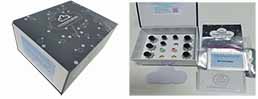
Packages (Simulation)
Reagent Preparation
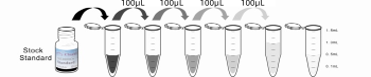
Image (I)
-
 Results demonstration
Image (II)
-
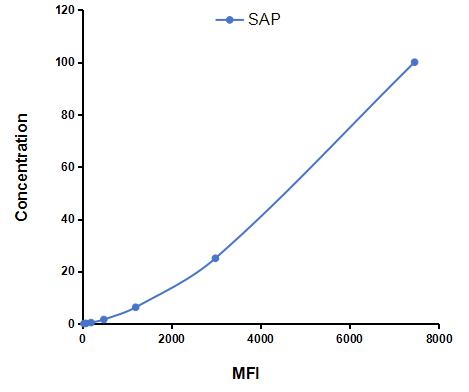 Typical Standard Curve
Quality Guarantee

Instruction Manual
Certificate
Multiplex Assay Kit for Serum Amyloid P Component (SAP) ,etc. by CBA (Cytometric Bead Array)
APCS; PTX2; Pentaxin-Related; 9.5S Alpha-1-Glycoprotein
- Product No.CMB539Hu
- Organism SpeciesHomo sapiens (Human) Same name, Different species.
- Sample TypeSerum, plasma, tissue homogenates and other biological fluids
- Test MethodDouble-antibody Sandwich
- Assay Length4h
- Detection Range0.0977-100ng/mL
- SensitivityThe minimum detectable dose of this kit is typically less than 0.0326ng/mL.
- DownloadInstruction Manual
- UOM 8Plex 7Plex 6Plex 5Plex 4Plex 3Plex 2Plex1Plex
- FOB
US$ 415
US$ 431
US$ 455
US$ 487
US$ 519
US$ 567
US$ 638
US$ 798
For more details, please contact local distributors!
Specificity
This assay has high sensitivity and excellent specificity for detection of Serum Amyloid P Component (SAP) ,etc. by CBA (Cytometric Bead Array).
No significant cross-reactivity or interference between Serum Amyloid P Component (SAP) ,etc. by CBA (Cytometric Bead Array) and analogues was observed.
Recovery
Matrices listed below were spiked with certain level of recombinant Serum Amyloid P Component (SAP) ,etc. by CBA (Cytometric Bead Array) and the recovery rates were calculated by comparing the measured value to the expected amount of Serum Amyloid P Component (SAP) ,etc. by CBA (Cytometric Bead Array) in samples.
| Matrix | Recovery range (%) | Average(%) |
| serum(n=5) | 86-97 | 91 |
| EDTA plasma(n=5) | 86-96 | 91 |
| heparin plasma(n=5) | 80-98 | 87 |
Precision
Intra-assay Precision (Precision within an assay): 3 samples with low, middle and high level Serum Amyloid P Component (SAP) ,etc. by CBA (Cytometric Bead Array) were tested 20 times on one plate, respectively.
Inter-assay Precision (Precision between assays): 3 samples with low, middle and high level Serum Amyloid P Component (SAP) ,etc. by CBA (Cytometric Bead Array) were tested on 3 different plates, 8 replicates in each plate.
CV(%) = SD/meanX100
Intra-Assay: CV<10%
Inter-Assay: CV<12%
Linearity
The linearity of the kit was assayed by testing samples spiked with appropriate concentration of Serum Amyloid P Component (SAP) ,etc. by CBA (Cytometric Bead Array) and their serial dilutions. The results were demonstrated by the percentage of calculated concentration to the expected.
| Sample | 1:2 | 1:4 | 1:8 | 1:16 |
| serum(n=5) | 92-101% | 88-95% | 81-99% | 81-91% |
| EDTA plasma(n=5) | 86-96% | 96-105% | 86-98% | 82-95% |
| heparin plasma(n=5) | 80-93% | 82-98% | 91-102% | 95-103% |
Stability
The stability of kit is determined by the loss rate of activity. The loss rate of this kit is less than 5% within the expiration date under appropriate storage condition.
To minimize extra influence on the performance, operation procedures and lab conditions, especially room temperature, air humidity, incubator temperature should be strictly controlled. It is also strongly suggested that the whole assay is performed by the same operator from the beginning to the end.
Reagents and materials provided
| Reagents | Quantity | Reagents | Quantity |
Assay procedure summary
1. Add 200μL analysis buffer solution to each well of the plate for pre-wetting;
2. Preparation of standards, reagents and samples before the experiment;
3. Add 100μL standard or sample to each well, add 10μL magnetic beads, and incubate 120 minutes protect from light at 25°C on shaker;
4. Remove liquid on magnetic frame, add 100μL prepared Detection Reagent A. Incubate 60 minutes protect from light at 25°C on shaker;
5. Remove liquid on magnetic frame, add 100μL prepared Detection Reagent B, and incubate 30 minutes protect from light at 25°C on shaker;
6. Wash plate once on magnetic frame;
7. Add 100μL sheath fluid, swirl for 10 minutes, read on the machine.
GIVEAWAYS
INCREMENT SERVICES
| Magazine | Citations |
| Journal of Vascular Surgery | Circulation levels of acute phase proteins in patients with Takayasu arteritis PubMed: 20100644 |
| Journal of Proteome Research | Combined Proteomic and Metabolomic Profiling of Serum Reveals Association of the Complement System with Obesity and Identifies Novel Markers of Body Fat Mass Changes ACS: pr2005555 |
| Liver International | Identification of candidate biomarkers for hepatocellular carcinoma in plasma of HCV-infected cirrhotic patients by 3-D DIGE Pubmed: 23944848 |
| Journal of Proteome Research | Targeted proteomics predict a sustained complete-response after transarterial chemoembolization and clinical outcomes in patients with hepatocellular carcinoma: a prospective cohort study pubmed:28112944 |
| American Journal of Reproductive Immunology | Amniotic fluid pentraxins: Potential early markers for identifying intra‐amniotic inflammatory complications in preterm pre‐labor rupture of membranes pubmed:29193454 |
| Theranostics | Serum amyloid P component therapeutically attenuates atherosclerosis in mice via its effects on macrophages Pubmed:29930724 |
| J Med Primatol | Proteopathic lesions in the brain of a super©\aged chimpanzee (Pan troglodytes) 34096618 |
| Clinical and Experimental Immunology | Clinical significance of differential serum-signatures for early prediction of severe dengue among Eastern Indian patients Pubmed:35348620 |