
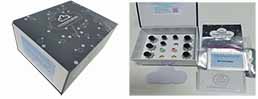
Packages (Simulation)
Reagent Preparation
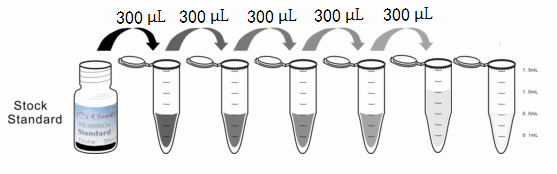
Image (I)
-
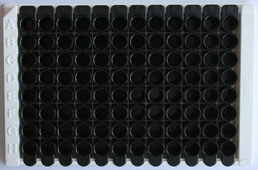 Results demonstration
Image (II)
-
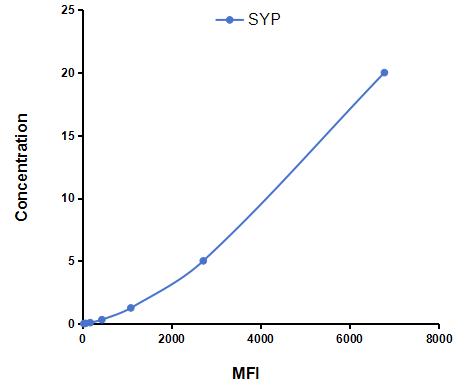 Typical Standard Curve
Quality Guarantee

Instruction Manual
Certificate
Multiplex Assay Kit for Synaptophysin (SYP) ,etc. by FLIA (Flow Luminescence Immunoassay)
Major synaptic vesicle protein p38
(Note: Up to 8-plex in one testing reaction)
- Product No.LMA425Hu
- Organism SpeciesHomo sapiens (Human) Same name, Different species.
- Sample TypeSerum, plasma, tissue homogenates and other biological fluids
- Test MethodDouble-antibody Sandwich
- Assay Length4h
- Detection Range0.02-20ng/mL
- SensitivityThe minimum detectable dose of this kit is typically less than 0.007 ng/mL.
- DownloadInstruction Manual
- UOM 8Plex 7Plex 6Plex 5Plex 4Plex 3Plex 2Plex1Plex
- FOB
US$ 499
US$ 518
US$ 547
US$ 586
US$ 624
US$ 682
US$ 768
US$ 960
Add to Price Calculator
Result
For more details, please contact local distributors!
Specificity
This assay has high sensitivity and excellent specificity for detection of Synaptophysin (SYP).
No significant cross-reactivity or interference between Synaptophysin (SYP) and analogues was observed.
Recovery
Matrices listed below were spiked with certain level of recombinant Synaptophysin (SYP) and the recovery rates were calculated by comparing the measured value to the expected amount of Synaptophysin (SYP) in samples.
| Matrix | Recovery range (%) | Average(%) |
| serum(n=5) | 90-98 | 94 |
| EDTA plasma(n=5) | 80-101 | 86 |
| heparin plasma(n=5) | 84-101 | 89 |
Precision
Intra-assay Precision (Precision within an assay): 3 samples with low, middle and high level Synaptophysin (SYP) were tested 20 times on one plate, respectively.
Inter-assay Precision (Precision between assays): 3 samples with low, middle and high level Synaptophysin (SYP) were tested on 3 different plates, 8 replicates in each plate.
CV(%) = SD/meanX100
Intra-Assay: CV<10%
Inter-Assay: CV<12%
Linearity
The linearity of the kit was assayed by testing samples spiked with appropriate concentration of Synaptophysin (SYP) and their serial dilutions. The results were demonstrated by the percentage of calculated concentration to the expected.
| Sample | 1:2 | 1:4 | 1:8 | 1:16 |
| serum(n=5) | 80-99% | 92-99% | 81-101% | 98-105% |
| EDTA plasma(n=5) | 78-101% | 80-94% | 93-105% | 89-102% |
| heparin plasma(n=5) | 94-105% | 96-104% | 78-93% | 84-101% |
Stability
The stability of kit is determined by the loss rate of activity. The loss rate of this kit is less than 5% within the expiration date under appropriate storage condition.
To minimize extra influence on the performance, operation procedures and lab conditions, especially room temperature, air humidity, incubator temperature should be strictly controlled. It is also strongly suggested that the whole assay is performed by the same operator from the beginning to the end.
Reagents and materials provided
| Reagents | Quantity | Reagents | Quantity |
| 96-well plate | 1 | Plate sealer for 96 wells | 4 |
| Pre-Mixed Standard | 2 | Standard Diluent | 1×20mL |
| Pre-Mixed Magnetic beads (22#:SYP) | 1 | Analysis buffer | 1×20mL |
| Pre-Mixed Detection Reagent A | 1×120μL | Assay Diluent A | 1×12mL |
| Detection Reagent B (PE-SA) | 1×120μL | Assay Diluent B | 1×12mL |
| Sheath Fluid | 1×10mL | Wash Buffer (30 × concentrate) | 1×20mL |
| Instruction manual | 1 |
Assay procedure summary
1. Add 200μL analysis buffer solution to each well of the plate for pre-wetting;
2. Preparation of standards, reagents and samples before the experiment;
3. Add 100μL standard or sample to each well, add 10μL magnetic beads, and incubate 120 minutes protect from light at 25°C on shaker;
4. Remove liquid on magnetic frame, add 100μL prepared Detection Reagent A. Incubate 60 minutes protect from light at 25°C on shaker;
5. Remove liquid on magnetic frame, add 100μL prepared Detection Reagent B, and incubate 30 minutes protect from light at 25°C on shaker;
6. Wash plate once on magnetic frame;
7. Add 100μL sheath fluid, swirl for 10 minutes, read on the machine.
GIVEAWAYS
INCREMENT SERVICES
| Magazine | Citations |
| Neuropsychopharmacology | Increased Amyloid-β Peptide-Induced Memory Deficits in Phospholipid Transfer Protein (PLTP) Gene Knockout Mice Nature: Source |
| United States Application US20140378440 | BACLOFEN AND ACAMPROSATE BASED THERAPY OF NEUROLOGICAL DISORDERS Read more: http://www.faqs.org/patents/app/20130090307#ixzz3VGRXUqW9 Faqs:Source |
| Scientific Reports | In Vivo Characterization of ARN14140, a Memantine/Galantamine-Based Multi-Target Compound for Alzheimer's Disease pubmed:27609215 |
| IOS Press Content Library | An Intranasal Formulation of Erythropoietin (Neuro-EPO) Prevents Memory Deficits and Amyloid Toxicity in the APPSwe Transgenic Mouse Model of Alzheimer's … articles:journal-of-alzheimers-disease |
| University of British Columbia | Investigating the roles of SRRM4 in contribution to neuroendocrine prostate cancer progression |
| pharmacological research | Neuroprotection in non-transgenic and transgenic mouse models of Alzheimer's disease by positive modulation of σ1 receptors Pubmed: 31048034 |
| Nutrients | Fermented Goat Milk Consumption Enhances Brain Molecular Functions during Iron Deficiency Anemia Recovery Pubmed: 31591353 |
| ACS Applied Materials & Interfaces | Tunable Substrate Functionalities Direct Stem Cell Fate toward Electrophysiologically Distinguishable Neuron-like and Glial-like Cells 33356098 |
| JOURNAL OF MOLECULAR NEUROSCIENCE | Enriched Environment Minimizes Anxiety/Depressive-Like Behavior in Rats Exposed to Immobilization Stress and Augments Hippocampal Neurogenesis (In Vitro) 33492617 |