
Packages (Simulation)
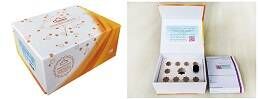
Image (II)
-
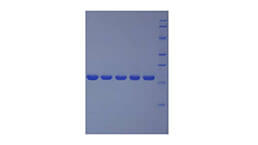
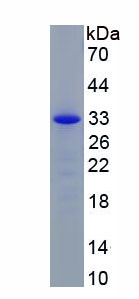 Figure. SDS-PAGE
Quality Guarantee

Instruction Manual

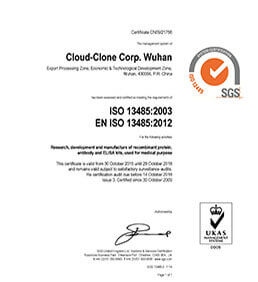
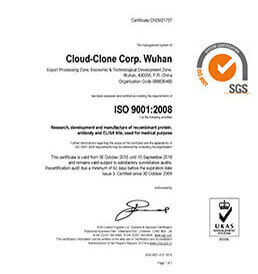
Certificate
Active Prostate Specific Antigen (PSA)
KLK3; APS; KLK2A1; HK3; KLKB1; Seminin; Prostate Specific Antigen; Kallikrein-Related Peptidase 3; Semenogelase, g-Seminoprotein; P-30 Antigen; Plasma kallikrein
- Product No.APA151Hu62
- Organism SpeciesHomo sapiens (Human) Same name, Different species.
- Buffer FormulationPBS, pH7.4, containing 5% Trehalose.
- Traits Freeze-dried powder
- Purity> 95%
- Isoelectric Point7.9
- ApplicationsCell culture; Activity Assays.
- DownloadInstruction Manual
- UOM 10µg50µg 200µg 1mg 5mg
- FOB
US$ 356
US$ 890
US$ 1780
US$ 5340
US$ 13350
For more details, please contact local distributors!
ACTIVITY TEST
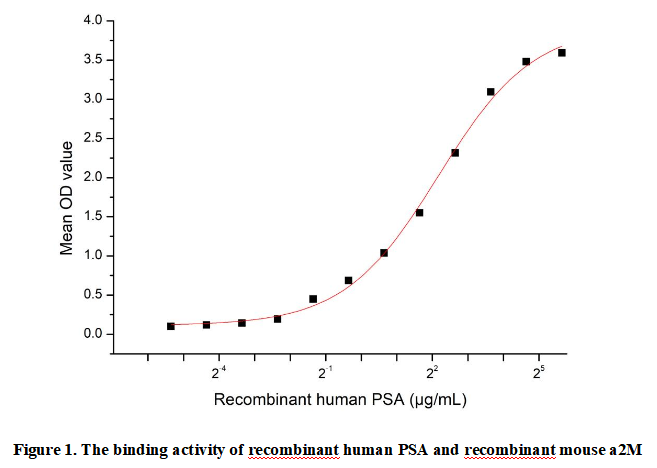
Prostate Specific Antigen (PSA) is a serine protease enzyme primarily produced by the epithelial cells of the prostate gland. Its key physiological function is to liquefy seminal fluid, facilitating sperm motility. Clinically, measuring serum PSA levels is a cornerstone for screening and monitoring prostate cancer, as elevated concentrations often indicate malignancy, though benign conditions like prostatitis can also cause increases. It is considered an important, though not perfectly specific, tumor marker. PSA can form complexes with other serum proteins, most notably with Alpha-2-Macroglobulin (a2M), a large plasma protease inhibitor. This binding irreversibly encapsulates PSA, effectively neutralizing its enzymatic activity and removing it from serological detection.Thus to detect the activity of recombinant PSA, a functional ELISA assay was performed to evaluate the interaction between recombinant human PSA and recombinant mouse a2M.
Briefly, biotin-linked PSA were diluted serially in PBS, with 0.01% BSA (pH 7.4). Duplicate samples of 100µl were then transferred to a2M-coated microtiter wells and incubated for 1h at 37℃. Wells were washed with PBST 3 times and incubation with Streptavidin-HRP for 30min, then wells were aspirated and washed 5 times. With the addition of substrate solution, wells were incubated 15-25 minutes at 37℃. Finally, add 50µl stop solution to the wells and read at 450nm immediately. The binding activity of PSA and a2M was shown in Figure 1, the EC50 for this effect is 4.5 µg/mL.
USAGE
Reconstitute in 10mM PBS (pH7.4) to a concentration of 0.1-1.0 mg/mL. Do not vortex.
STORAGE
Avoid repeated freeze/thaw cycles. Store at 2-8°C for one month. Aliquot and store at -80°C for 12 months.
STABILITY
The thermal stability is described by the loss rate. The loss rate was determined by accelerated thermal degradation test, that is, incubate the protein at 37°C for 48h, and no obvious degradation and precipitation were observed. The loss rate is less than 5% within the expiration date under appropriate storage condition.
GIVEAWAYS
INCREMENT SERVICES
-
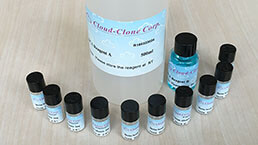 BCA Protein Quantification Kit
-
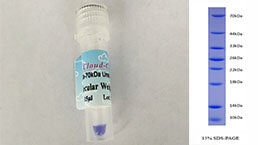 Molecular Mass Marker for Protein
-
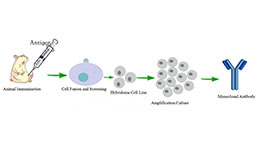 Monoclonal Antibody Customized Service
-
 Polyclonal Antibody Customized Service
-
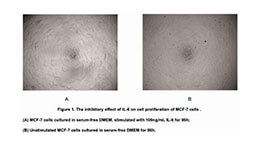 Protein Activity Test Experiment Service
-
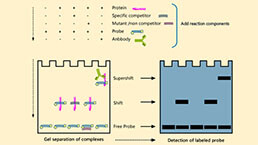 Electrophoretic Mobility Shift Assay (EMSA) Experiment Service
-
 Buffer
-
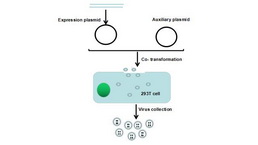 Lentivirus Packaging Experiment Service
-
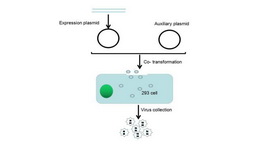 Adenovirus Packaging Experiment Service
-
 Real Time PCR Experimental Service
-
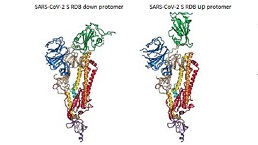 Spike RBD Protein (S-RBD)
-
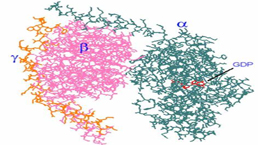 Protein G
-
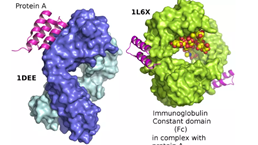 Protein A
| Magazine | Citations |
| The Journal of Nutritional Biochemistry | Vitamin C supplementation prevents testosterone-induced hyperplasia of rat prostate by down-regulating HIF-1α ScienceDirect: S0955286309001181 |